Thursday, December 26, 2013

More wildlife in Hartford


Who’s that visiting a solar panel at the Hartford landfill?

A snowy owl – that’s who.


Snowy owls summer in the Arctic and normally don’t migrate this far south in the winter, but more of them are visiting Connecticut this year.

You can learn more about snowy owls and their migration from the Cornell University snowy owltracker, Discovery News and BirdNote.

It’s more evidence of what we’ve been saying for years – under CRRA’s management theHartford landfill has become a valuable wildlife habitat right in the middle of the city.

Tuesday, October 1, 2013

A good explanation of Connecticut's bottle bill (and an illustration of its faults)

The Hartford Courant's consumer column addresses a problem with returning empties reported by one person (though this vexes many, many people):
"Yet, they do not — or are not required to? — accept the empty containers back and return the deposit to the customer."How is this allowed? We are forced to schlep the empty containers to a grocery store or liquor store, which accepts them. An example is Fiji water, which we love. There may be a great sale at CVS, but not every grocery store sells it, and I have to find one that will accept the empties back. Can you explain this phenomenon?"
 The Bottom Line, Sept. 30, 2013

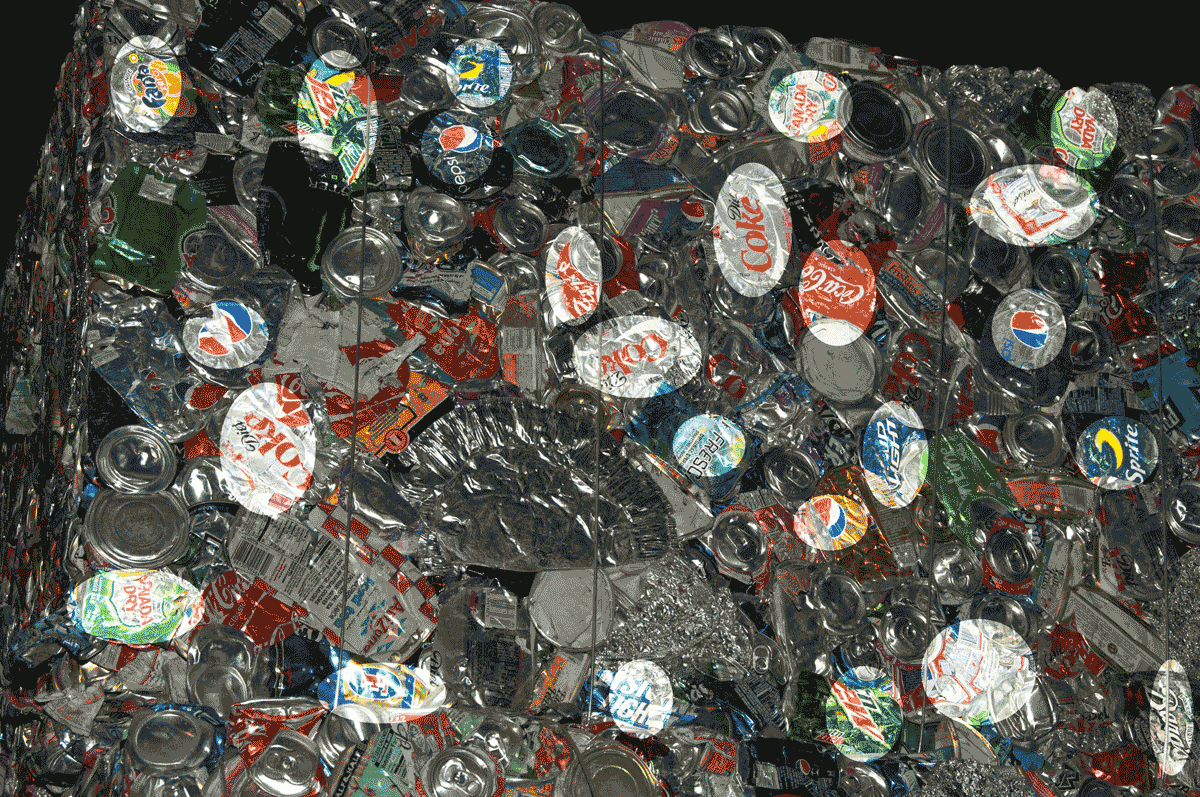
People have been complaining about this for years, and our experience shows people prefer the ease and convenience of curbside recycling over the hassle of schlep[ping] the empties to the individual stores that sell them. This photograph, taken at CRRA's recycling processing center in Hartford, bears that out.


This is a bale of aluminum cans and foil ready to be shipped from our processing center. Highlighted are just a few of the deposit cans that people placed in their curbside recycling bins rather than "schlep the empty containers" whence they came -- even if it means losing their deposits.


Tuesday, August 27, 2013

TEDx talk: Everything has potential

Not long ago our Paul Nonnenmacher gave a talk at the TEDx Bushnell Park event on how even the most objectionable places can house incredible things:
TEDx Bushnell Park

Friday, August 23, 2013

Still revolutionary? Yes!

Our friend of many years, Paul Kallmeyer, recently sent us something he came across while going through some old items. This flag was used to introduce recycling to southwestern Connecticut cities and towns back in 1991, and Paul was one of the leaders of that movement.

Recycling was a revolution back then. "You mean we can't just put everything in the garbage can anymore?" was commonly heard.


Since its introduction, recycling has expanded; we can now recycle junk mail, catalogs, magazines, large plastic items, phone books and many more items that couldn't go in the recycling bin back then. Today, Connecticut has the most sustainable solid-waste system in the country, and one of the best in the world, because of our state's use of trash-to-energy and aggressive recycling.

Monday, August 5, 2013

Another view from the top

David K. Leff, who says his blog is about "discovering the commonplace world near at hand" and "exploring wonders hidden in plain sight," visited the Hartford landfill recently. Here's what he found:

http://davidkleff.typepad.com/home/2013/07/a-citys-accidental-high-meadow.html#more

Monday, May 20, 2013

The eagles agree

For many years we've been saying that turning trash into electricity is the most environmentally responsible method of dealing with garbage. A family of American bald eagles agrees so strongly that they've become our Hartford plant's next-door -- or next-tree -- neighbors.

At left is a map of the South Meadows area of Hartford highlighting the two sections of CRRA's trash-to-energy plant. The eagle icon marks the location of a large tree where, for several years, eagles have nested. We've noticed the eagles many times over the years but it wasn't until earlier this month that we got good pictures of the eagles.

Bruce Morrell, a shift supervisor at the power facility, paddled his kayak onto the Connecticut River and, with a Canon 60D camera got some spectacular images.

Here's one of the eagles bringing the catch of the day back to the nest, where two hungry eaglets are waiting.


The section of the river adjacent to the plant is prime fishing territory for birds and humans. A small fish called an alewife attracts larger fish like bass, carp and perch, and since alewives seem to like the waters around the plant the area is popular with fishermen of all species.

You can see the two babies in the image below. One is inside the nest while the other appears to be sitting a little higher.


Below are mom and dad with the little ones safely beneath them.


In all of nature, there are few things more spectacular than seeing an American bald eagle in flight. To have a family of them living next to our trash-to-energy plant is special.


In the image below, one of the eaglets is sitting alongside mom.


Here's one of the young ones trying his (her?) wings.


This adult can see for miles and miles . .  .


Thursday, June 28, 2012

The view from up here

We were atop the Hartford landfill this morning and were taken by the view on this clear day. When we complete the installation of a synthetic cap and turn the landfill over to the City, here's a glimpse of what the people of Hartford will be able to enjoy:


The landfill has unmatched views of the surrounding area, including the Hartford skyline:


The wild flowers are in bloom, adding to the scene.

Wednesday, March 21, 2012

While some people still fight the last war, CRRA is tackling new challenges

CRRA sent the following to members of the legislature’s Government Administration & Elections Committee and Energy & Technology Committee on March 21:

Recently two legislative committees heard testimony that included some rather harsh accusations about CRRA. Making these accusations was a lobbyist representing employees of a former CRRA contractor. However, in re-fighting a battle that a Superior Court judge declared was over, the lobbyist painted a picture of CRRA that is, to put it mildly, inaccurate. Please allow us to correct the record with a few facts.

CRRA is open and transparent. All CRRA meetings are public – in fact several times over the years this same lobbyist has made those same accusations during the public-comment portions of our meetings. While CRRA has been inundated with Freedom of Information requests for many years – many by this former contractor and its network of allies – since the legislature reconstituted CRRA in 2002 the Freedom of Information Commission has never found CRRA to be in violation of open-meetings or open-records laws. Despite the fact that these requests have been costly and burdensome, CRRA has complied fully with each and every request.

Section 22a-268 of the Connecticut General Statutes requires CRRA to use private contractors to operate its facilities. When the contracts to operate CRRA’s largest facility, the Mid-Connecticut Project trash-to-energy facility in Hartford, were nearing their expiration CRRA undertook a public and transparent competitive procurement process to select the best contractor to operate and maintain the plant.

In December 2010, after a 15-month evaluation process, CRRA awarded a contract to the most qualified and lowest-cost bidder, NAES Corporation, to begin operating the plant in December 2011. Almost immediately one of the incumbent contractors sued, claiming CRRA and its selection process were biased. The case went to trial, and after hearing 10 days of testimony and reviewing over 200 exhibits, Superior Court Judge Julia J. Aurigemma rendered a 45-page decision upholding the award of the contract to NAES.

Judge Aurigemma wrote: “The CRRA acted fairly and in a non-discriminatory manner with respect to all bidders in the process, including the (incumbent contractor/plaintiff). The (incumbent contractor/plaintiff), on the other hand, went through the motions of participating in the procurement process while at the same time attempting to legislate the CRRA out of existence.”

In court, it was shown that the incumbent contractor did not act to retain the contract or protect the jobs of its employees. In contrast CRRA required the successful bidder to offer jobs to all the incumbent contractors’ employees at their existing wages. None of those workers lost their jobs.

NAES has proven to be a quality operator. In less than three months, NAES met or exceeded the productivity levels that the former contractor took 24 years to reach.

Furthermore, NAES has quickly and satisfactorily implemented the rigorous safety protocols CRRA requires.

CRRA is pleased with the performance of its new contractor and our customer towns are delighted with the millions in savings for their taxpayers. However, CRRA does face imminent challenges due to collapsing energy markets. Trash-to-energy system has two primary sources of revenue: disposal fees and electricity sales. With robust power prices, CRRA’s disposal fees fall, easing the burden on municipalities, residents and businesses whose trash CRRA manages.

Because natural-gas prices collapsed in the second half of 2011, power prices followed suit. When our new power contract takes effect in less than three months, CRRA will sell its electricity at an all-time low price. Regrettably, this is jeopardizing the lower disposal prices we have offered our customers and, more importantly, risks the 30 years of environmental progress Connecticut has made in managing its solid waste responsibly by forcing hundreds of thousands of tons of trash onto trucks bound for out-of-state landfills.

To combat this, CRRA supports HB 5118, which would make trash-to-energy a Class 1 renewable power source. The premium electric suppliers must pay for Class 1 renewable would ensure the economic viability and the environmental safeguards trash-to-energy offers. The state of Maryland has already taken this step, and we believe it is important for Connecticut to do the same.

Just as there are some generals still fighting the last war, there are some special interests who are still trying to re-litigate a case that clearly validated CRRA’s performance. Thank you for the opportunity to insure that these claims, inaccurate and counter to the facts, do not enter the record unchallenged.

Wednesday, August 10, 2011

You ask, we answer

George asks: Most oil and hazardous liquids come in a number 2 plastic bottle. These are things a homeowner would have a lot of, like, oil, antifreeze, weed killer or dozens of other products that come in these containers. If the bottles are washed out, can they be recycled and if not why?

George: You raise a good point, but the situation you describe is not unlike our experience with another recyclable material, namely cardboard. Pizza comes in cardboard boxes, and there was a time when we said pizza boxes were acceptable if they were clean. We soon found out that different people had different definitions of "clean," and soon we were getting pizza boxes that were greasy or had cheese stuck to them, and before long it was just easier to not accept pizza boxes at all.

The point here, and we do have one (apologies to Ellen DeGeneres), is that it's easier to just ask people to bring these materials to a hazardous-waste collection, ensuring the contents will be safely disposed of.

Friday, February 4, 2011

These kids get it -- do you?

Check out this video made by children at Mary M. Hooker Environmental Sciences Magnet School in Hartford:

Tuesday, December 21, 2010

Maybe there, but not here

You may have heard a story on NPR called "After Dump, What Happens To Electronic Waste?" which told the oft-told tale that electronics recycling isn't always what it seems.

Maybe that's true elsewhere, but not for residents of towns that rely on CRRA for electronics recycling. We contract with eco International, one of the nation’s electronics recycling leaders, to keep these items out of the waste stream. At its facility in Vestal, N.Y., eco International dismantles items into raw materials, such as copper, steel, aluminum, glass and plastic, and sells these materials to firms who turn them into new products.

eco International has signed the Basel Action Network Pledge of True Stewardship, an internationally recognized commitment to responsible recycling and has been audited by CHWMEG, Inc.; results of that audit can be reviewed on-line.

We're not saying this to brag, but merely to reassure you that we're doing everything we can to provide this service the right way.

We're also awaiting word that the statewide electronics recycling program being crafted by the Connecticut Department of Environmental Protection is ready to launch.

Thursday, December 9, 2010

We've inspired a holiday tree

There's a new holiday tree in the center of Stratford, and it's made from recycled materials.

Local business leaders got the idea in the spring at the grand opening of the Garbage Museum's first professional art exhibit. They saw how people react to Trash-o-saurus and wanted to create the same effect in their central business district.

You can read more here and here.

Thursday, November 11, 2010

Phone books on the verge of extinction?

Just noticed this item about the possibility of telephone directories being phased out.

One of the most frequent questions we're asked is about recycling of phone books. We can't accept them because the binding fouls our processing equipment. Telephone companies have blue barrels outside their offices and local switching equipment buildings for recycling the books.

Friday, November 5, 2010

And remember us?????

We couldn't help but notice this editorial headlined "Remember Renewable Energy?" in The New York Times the other day.

According to the U.S. Energy Information Agency, three of the top 10 renewable energy producers in New England are trash-to-energy plants. Our own Mid-Connecticut Project facility is the fourth-largest in the six-state region.

Not only are we making electricity with a fuel supply that is endless (at least until someone waves a magic wand and turns this into a zero-waste society), it reduces by 90 percent the amount of landfill space we need for our solid waste.

And, in a 2002 letter, U.S. EPA Assistant Administrators Jeffery Holmstead and Marianne Lamont Horinko recognized the “vital role of the nation’s municipal waste-to-energy industry” and concluded that “these plants produce 2800 megawatts of electricity with less environmental impact than almost any other source of electricity.”

Just sayin'.

Thursday, September 9, 2010

Our Museums' record summer

Green is hot. And it’s cooler than ever. At least in Connecticut.

This summer, more people visited the CRRA Trash Museum in Hartford and Garbage Museum in Stratford, and more people took part in their award-winning sustainability education programs, than in any other summer on record.


The table you see here tells the story. In July and August, almost 9,000 people turned to our Museums to learn about recycling, energy conservation, composting and other hot green topics. Over 3,100 people visited the Garbage Museum in the summer vacation months.

Year-to-date, we’re not far off the pace we set in 2008, when both Museums enjoyed record numbers.

We’re proud of our education programs, proud of our educators and confident that our efforts are making a difference in our environment.

By the way, have you become a fan of the Trash Museum or the Garbage Museum on Facebook?

Monday, August 30, 2010

We know there are fewer bottles being recycled, but are people really buying less bottled water?

Recently you may have heard or read that the state isn’t taking in as much money from unclaimed deposits on plastic water bottles as some officials had hoped.

In 2009 Connecticut expanded its bottle bill to put five-cent deposits on plastic water bottles, the same deposit Connecticut consumers pay on beer and soda bottles and cans. But where the bottlers and distributors keep the nickels from unredeemed beer and soda containers, the state would keep the unclaimed water deposits.

When the legislation was passed in 2009, state officials said they expected to take in $17 million a year in unclaimed water bottle deposits. At 20 bottles per dollar, that would have required 340 million bottles going unredeemed every year, out of estimated annual sales of more than 500 million bottles, a number used by both the state and the Container Recycling Institute, a bottle-bill proponent.

The expansion took effect on Oct. 1, 2009. While numbers for the full fiscal year (which ended June 30) are not yet available, in April it was reported that the state only collected $680,000 from January through March of 2010. That’s 13.6 million unredeemed bottles for those of you without a calculator handy.

As far back as 2007, CRRA had been warning of the unintended consequences of putting a deposit on water bottles – namely, the adverse impact it would have on curbside recycling. CRRA processes the recyclables collected from residents of 76 cities and towns at no cost to those towns. (Those same towns pay as much as $69 per ton to bring us their garbage, underscoring the fiscal benefits of recycling.)

The larger of our two recycling systems, the Mid-Connecticut Project, has an annual budget of about $1.4 million, all paid for by proceeds from the sale of paper, cardboard, aluminum, steel, glass and plastic we sort and bale at our recycling processing facility in Hartford. In fact, because the 64 Mid-Connecticut Project recycling towns continue to increase their recycling rate, they’ve generated enough revenue to allow us to pay them rebates in 2008 and 2009. (We don’t have final figures for this year yet.)

That’s all good news. But the situation could have been even better, because it appears people have dramatically reduced their purchases of bottled water. How do we know? If the state is collecting fewer unredeemed deposits than it anticipated, then if consumers are buying the same number of bottles, CRRA and other recyclers should be seeing more.

However, our Mid-Connecticut system saw a substantial dropoff in the amount of polyethelene (PET, or #1 plastic), the material of which water and soda bottles are made, starting last October. Consider: in the nine months before the expansion took effect, we processed and shipped about 223 tons per month of PET. In the first nine months after the expansion, we processed and shipped about 156 tons per month, a 30-percent drop.

This chart shows those month-by-month figures. The dropoff hit in October 2009, exactly when the expansion hit.


The 67 tons of plastic represents about 29 million fewer bottles purchased in Mid-Connecticut towns. Extrapolated over the population of the entire state, that’s about 90 million fewer water bottles in those nine months – far more than the difference between what the state anticipated and what actually happened.

More to the point, that loss of plastic hurts curbside recycling, which, as we said earlier, depends on revenues from sales of recycled materials. In June, a ton of #1 plastic fetched about $400 on the commodities market. Commodity prices fluctuate, but even at $300 per ton those 67 tons per month cost the Mid-Connecticut system just under $250,000, or almost one-fifth of the entire year’s budget.

Friday, July 9, 2010

Marion launches a revolution?

We introduced you to our friend Marion, who was concerned about all the paper her children brought home from school and whether their school recycled.

Now comes this story from Southborough, Mass., with a parent voicing a similar question.

Here in Connecticut, the standard state science curriculum includes an Earth Science component, usually in Grades 4 and 6. In many schools, that component includes a trip to either our Garbage Museum in Stratford or our Trash Museum in Hartford, where our educators get students excited about recycling, teaching them that a lot of seemingly small actions can add up to a big positive impact on our environment.

It's frustrating to find out that some schools aren't always reinforcing this message.

Parents: do your schools recycle?

Teachers and administrators: do your schools recycle?

Thursday, April 15, 2010

A sober look at trash-to-energy

The New York Times this week spent a good deal of bandwidth on the merits of trash-to-energy.

On Monday, The Times published a story headlined "Europe Finds Clean Energy in Trash, but U.S. Lags" that described the use of trash-to-energy in Denmark.

According to the story:
Their use has not only reduced the country’s energy costs and reliance on oil and gas, but also benefited the environment, diminishing the use of landfills and cutting carbon dioxide emissions. The plants run so cleanly that many times more dioxin is now released from home fireplaces and backyard barbecues than from incineration.


The story cites a study done by EPA and North Carolina State University that determined trash-to-energy is much more environmentally-responsible than landfilling.

On Tuesday, The Times's online edition kicked off a discussion entitled "Should the U.S. Burn or Bury Its Trash?"

The discussion ventured into the ideas of zero-waste and massive recycling systems as practiced in Japan and some European nations. These are both worthy ideals, but most Americans want convenience -- even if it costs a little more -- and these systems aren't convenient enough.

Connecticut's solid waste hierarchy, as established in Sec. 22a-228b of the Connecticut General Statutes, has led to Connecticut's recycling about 25 percent of its solid waste. There's certainly room for improvement with some reasonable steps -- more processing infrastructure to cut down on transportation costs, help for communities that want to switch to single-stream recycling and automated collection but can't afford the capital investment, more enforcement of the state's recycling laws and regulations -- but even with all these steps, until we get to zero-waste we're still going to have garbage to get rid of. Trash-to-energy really is the best option.

Friday, March 5, 2010

Ash Landfills: Someone’s Gotta Have Them

Kendra Richardson wrote this piece for her Magazine Journalism course at the University of Connecticut:

Ash landfills are necessary in Connecticut, whether residents like it or not. These landfills, a disposal site for what’s left after garbage is incinerated, are not developed until the state Department of Environmental Protection has ensured they met environmental standards. Yet the idea of dumping ash is a scary concept for residents who live near the sites.

On March 26, 2008, the Connecticut Resources Recovery Authority announced it had chosen Franklin as the site for a new ash landfill. The small town is located in the “Last Green Valley” of northeastern Connecticut.

The CRRA chose a 350-acre site in Franklin, of which approximately 90 acres would be used as the actual landfill. The remaining acres would act as a buffer between the landfill and the surrounding residential area.

Residents of Franklin quickly protested, and now the CRRA has announced it will suspend its efforts to develop the landfill. However, a need remains since the Hartford landfill has reached capacity and closed down in late 2008 after 64 years of operation.

Connecticut now has one active ash landfill in Putnam. This is privately owned by Wheelabrator Technologies Incorporated. According to Robert Jacques, Wheelabrator’s Manager of Business Development, the landfill has space to accommodate ash for 17 years. However, according to Paul Nonnemacher, the CRRA’s Director of Public Affairs, the estimated 17 years may be correct, but not exactly accurate.

Wheelebrator’s Putnam landfill accommodates space for out-of-state plants that bring their ash in. Nonnemacher said that after nine years the landfill will have reached its capacity with in-state ash and that the remaining eight years is reserved for out of-state plants. Nonnemacher said, “Whatever is there [Putnam] is a short term solution, to a very long term problem. Garbage is not going to go away, and Putnam is not the best solution.”

This leaves Connecticut with unresolved trash problems. Why wasn’t an ash landfill installed in Franklin? In order to answer this question a person needs to understand the disposal process.

Connecticut is one of the approximately 30 states in the U.S. that uses an alternative energy process for waste disposal. There are six plants currently running in Connecticut. Ash, the non-combustible residue left after incineration, has been dumped in Hartford or Putnam for years. Its wet consistency means it does not blow in the wind and residents of the surrounding area in Putnam have never had a problem with it.

Jessica Wilson, a resident of Woodstock who lives on the Putnam town line, said, “I have never had a problem with the landfill, it never really even comes up in town news. All I know is it brings in money for the town of Putnam. I’ve never even noticed trucks carrying ash.”

Correct she is —— the landfill does bring Putnam money. The landfill is expected to bring in almost $3 million this year.

The ash that is left from the incineration process, which is about 70 to 80 percent less by volume than before, must go somewhere. That is where the landfill comes in. Trucks carry the ash from the incinerator to a landfill, where the ash is dumped into a massive pool-like deposit area.

When Franklin residents caught wind of the CRRA’s plan to start testing the proposed site for the landfill, the town went into an uproar. Residents started a campaign called “Dump the Dump.” Even months after the plan was squashed, yellow signs appear plastered on nearly every family’s front lawn reading, “DUMP the DUMP! Keep Franklin Green and Clean.” Many residents were determined to stop an ash landfill from being developed.

Residents expressed legitimate fears. Their fears included a traffic increase on Route 32, the possibility of the landfill leaking, hundreds of acres of the beautiful country land being ruined, toxins flowing into the air and into their drinking supply, the threat to biodiversity, and archeological history being destroyed. They said it could lower property value as well, and raise unknown environmental concerns.

Nonnemacher believes residents concerns were unfounded.

“I would not feel bad [to have such a facility near his house] because I understand how these things are built, engineered and operated. And so, if they found a site that met the criteria, I wouldn’t have a problem with it,” he said. “Even if I lived next door, I wouldn’t have a problem with it because I know enough about them.”
Nonnemacher said however that while these fears were genuine, they simply were not backed up by factual information. He said the potential of a double-lined landfill leaking was slim to none.

“The facts and the science indicate there was no cause for concern here,” he said, “Nobody else had ever monitored the groundwater [before we had]. DEP would not let us build there if there was any indication that there were any possibility chemicals could get into their drinking water. No cause for concern on this score either.”

The ash landfill would have three layers of plastic liners, two layers of clay liners, would sit more than five feet away from the ground water, and two wells would monitor on opposite ends of structure. Also, the DEP requires that ash landfills are built adjacent to a Class-B river or stream, thus making the Shetucket River a very viable option. The DEP would prohibit a landfill from being built anywhere near a body of water that was used for drinking.

Nonnemacher said Windham once operated an ash landfill that has since closed down, but remains unlined. He said water flows under this unlined ash landfill upstream from the Franklin site, and into the Shetucket River where swimming and fishing is permitted. There have been no ill effects from old ash landfill and the DEP has not deemed the fish unsafe to consume. Yet, there is still a huge objection to a safer, new ash landfill.

Another main concern is destruction of the land. Of the 695,000 acres in the Last Green Valley, 90 of that would be transformed to accommodate the landfill. The CRRA assured residents that only those acres would be excavated and the remaining would be left in its natural state. The Putnam landfill, in accordance, has walking trails and paths that the town has maintained since it opened. The CRRA also speculates that since there is a reasonable amount of gravel underneath the Franklin property, there is a good chance a mining operation could be installed. If this were the case—the excavation would far exceed that of the CRRA’s.

In May of 2009, Wheelabrator held a 10th-anniversary celebration for visitors who were interested in learning more about the site. According to an article in the Norwich Bulletin, residents were provided with charts and graphs to help them understand the intricate process of the landfill. They were also given samples of honey made by the on-site beehives, and flower seeds that were grown there, as well. Author James Mosher said, “former skeptics were won over.”

Johanne Boisvert, a resident who lives only miles from the Putnam ash landfill, said the site is “perfect for walking your dogs, it's peaceful and quiet. I don’t think many people even know the walking trials are on the site of a landfill.”

Now that there is no potential for an ash landfill in Franklin, residents have suggested the CRRA begin to look elsewhere. The conundrum lies in where else the state should put the landfill. The CRRA says it did extensive research and Franklin was absolutely the best place. The Franklin residents have also suggested the CRRA try to find another spot. If an ash landfill is unacceptable in their town, however, why would other towns want them? Franklin residents are offering ideas that are really not a solution.

After the plan was squashed, the CRRA went back and checked all of its work and checked if there were any other potential sites in Connecticut. Nonnemacher said, “we sent a letter to every town in Connecticut except Franklin and asked them if they may happen to know a site that would be suitable for one. A couple of towns did offer sites, but they didn’t meet all the criteria.”

Nonnemacher said they contacted Cheshire, Conn., but it was “just an effort to make sure we didn’t overlook anywhere.” He said CRRA is shopping for privately owned landfills.

Since the Hartford landfill closed, the CRRA has been sending ash to privately owned companies, which has increased in price by 14 percent. Sending the ash out of state would cost Connecticut taxpayers even more money.

For right now, Nonnemacher urges Connecticut to recycle as much as possible as they try to figure out the best solution to this problem.